Meet the candidate
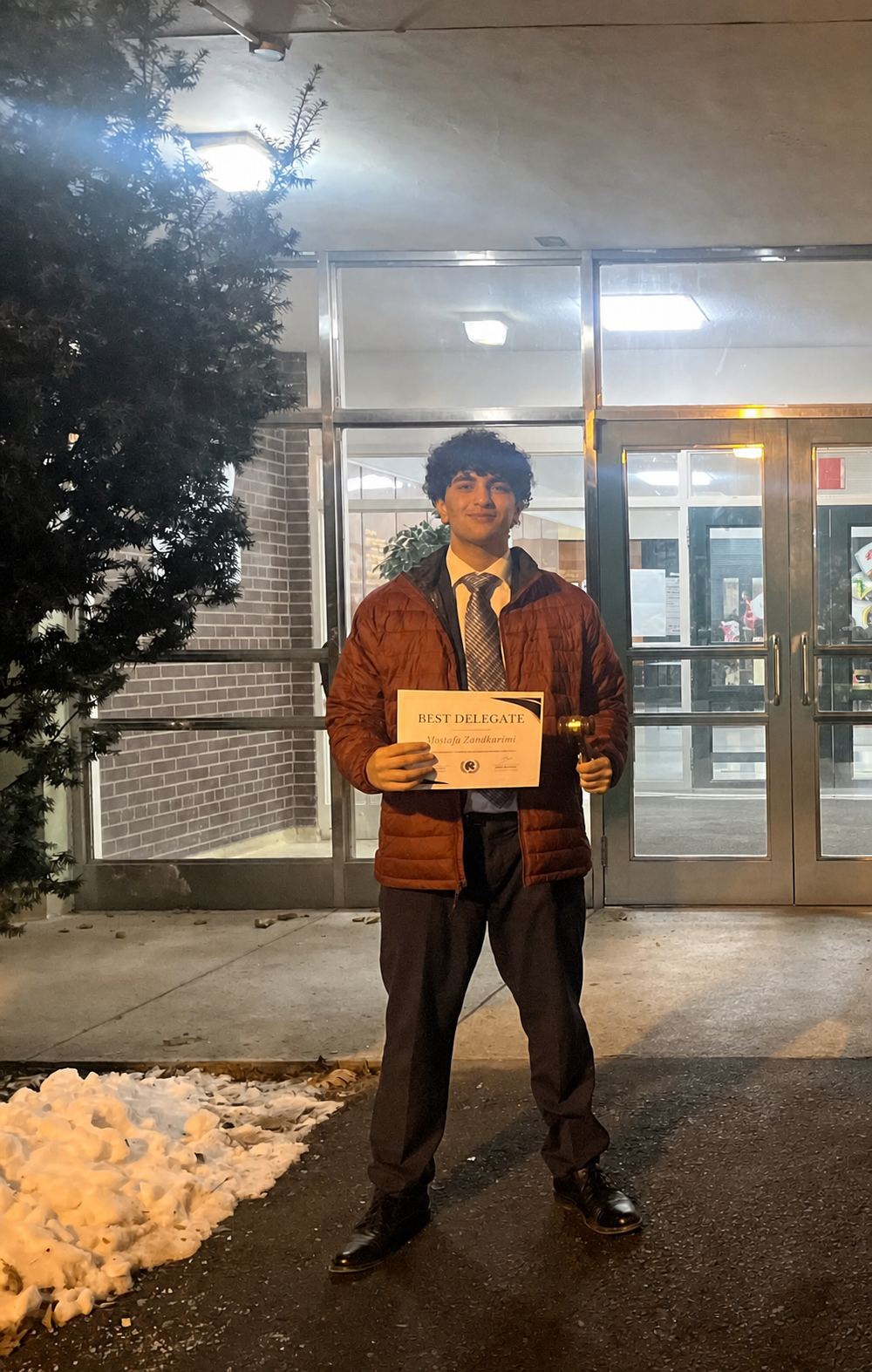
Mostafa
Zandkarimi.
Official ballot nameMostafa Zandkarimi
01 / In brief
Serious thought, rigorous evidence, and practical leadership in the service of Toronto's public life.
Mostafa Zandkarimi is a Toronto-based student, editor, civic researcher, youth leader, and 2026 candidate for Mayor of Toronto. His interdisciplinary work sits at the intersection of public affairs, political thought, education, law, technology, and community life.
Mostafa's work has rarely stayed in one lane. He has edited a journal, led a Model UN program, worked in youth programming, completed a legal co-op, organized a school snack program, and built a research system about Toronto. The projects look different on the surface. Underneath, they come from the same curiosity: why do some institutions earn people's trust while others make even simple things difficult?
A Toronto education
He grew up in Toronto in a family with Iranian and Kurdish roots, and learned early that public life looks different depending on the language spoken at home, the neighbourhood outside the window, and the institutions a family encounters. Politics interested him, but so did the ideas beneath it—philosophy, religion, history, law, literature, technology, and the competing accounts of justice that shape what governments believe they owe people.
At Forest Hill Collegiate Institute, Mostafa served as President of both Model United Nations and the Debate Club and as Vice President of the Asian Student Alliance. He graduated in 2026 as an Ontario Scholar, completed the Specialist High Skills Major in Business, and accumulated more than 250 hours of community service. He participated in Young Politicians of Canada and spoke at the Canada Youth Changemakers Summit. In September 2026, he will enter the University of Toronto's Faculty of Arts and Science, where his studies will bring together philosophy, Jewish studies, and science, technology, and society.
The work behind the title
Mostafa founded and edits Midah, an independent Toronto publication for politics, theology, literature, culture, essays, interviews, and poetry. Six open-access issues have been published so far. Building the journal has meant choosing work, planning issues, researching and writing, corresponding with contributors, and deciding what kind of intellectual space the publication should become.
Other parts of his experience have been more immediate and less visible. During a supervised placement at Grinhaus Law Firm in 2024, he saw the precision and organization expected in legal practice. At The Ivy Day Camp, where he eventually became an Assistant Unit Head, leadership meant keeping young people and staff organized while plans changed around them. The snack program meant logistics, follow-through, and making sure students could actually use what had been arranged for them. Those details matter to him because institutions are ultimately judged in ordinary moments: whether someone answers, whether a service arrives, whether the plan works when a person needs it.
Why research became a campaign
When Mostafa filed his nomination for Mayor of Toronto in 2026, he did not begin by drafting a list of promises. He began by trying to understand the city more completely. That work became the Toronto Issue Intelligence Observatory, a structured record of service failures, backlogs, inequities, pressures, contradictions, and unanswered questions across housing, transit, infrastructure, public safety, municipal finance, accessibility, social services, public health, parks, and governance.
The first baseline compiled 83 issue records from 129 retained sources across 40 categories, with frameworks covering all 25 wards and Toronto's 158 official neighbourhoods. The numbers are not a platform and they are not a ranking of what matters most; they are a way to keep evidence intact before political conclusions are placed on top of it.
Ideas have to survive contact with real life
Mostafa is fascinated by the machinery behind public life: reports and budgets, laws and datasets, administrative routines, historical arguments, new technologies, and the moral assumptions hidden inside apparently technical decisions. His interest in artificial intelligence follows the same path. He sees it as a useful tool, but also as a political and philosophical problem that will affect education, law, public administration, work, and the distribution of power.
There is an ambitious side to his work, and an organizational one. A publication still needs an issue plan. A student organization still needs a meeting to run on time. A research system still needs sources that can be checked. A campaign still needs to listen before it claims to know. The question tying these efforts together is straightforward, even when the answer is not: how can serious thought and practical leadership be brought into the service of a city?
The campaign
Now, the work turns to Toronto.
Explore the listening agenda, the policy-development standard, and how to take part in the 2026 mayoral campaign.
Visit the campaign